
New paper: Spatial and seasonal variation in avian dietary strategies
New Paper out!
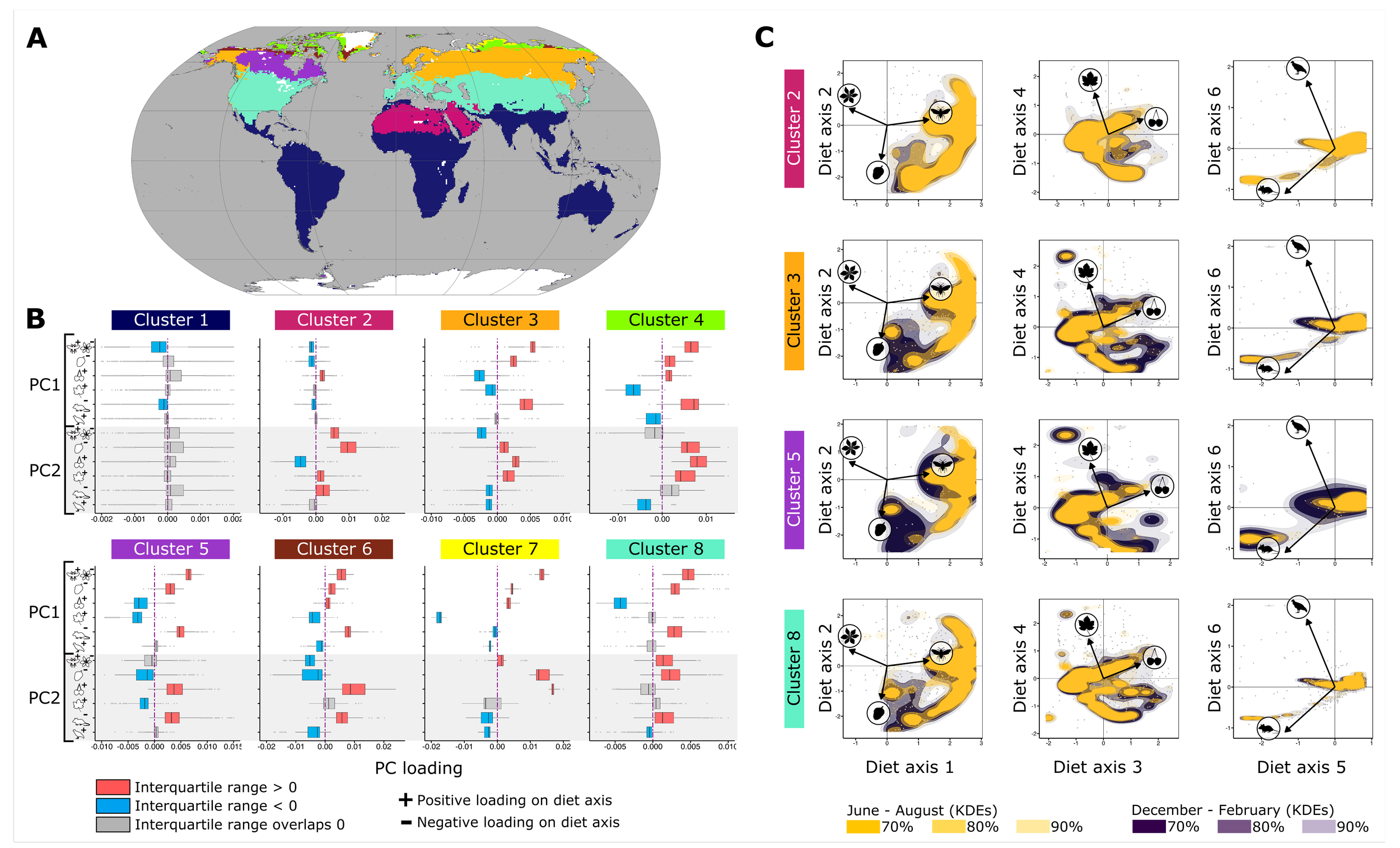
André, Reymond, and Marta published a global-scale assessment of the seasonality of dietary space and its environmental drivers. We show strong seasonal variation in birds’ dietary space at both the assemblage and species levels globally, with the most pronounced intra-annual dietary shifts occurring in the temperate and boreal regions of the Northern Hemisphere.
Abstract
Diet is a fundamental aspect of vertebrate life history, shaping survival, recruitment, and fitness. While spatial variation in avian dietary characteristics has been studied, seasonal dynamics at species and assemblage levels remain largely unexplored, hindering our understanding of biodiversity patterns and processes. We present the first global-scale assessment of seasonal variation in avian dietary space and its environmental drivers. We integrated seasonal species distributions for over 10,000 bird species with the SAviTraits 1.0 database, a compilation of intra-annual variation in species-specific dietary preferences. We summarized the avian dietary space using a Log Ratio Analysis and identified the dominant components of seasonal variation in avian dietary space using a Principal Component Analysis. To assess species contributions to the seasonality of assemblage-level dietary space, we quantified species-level annual variability in dietary characteristics. Finally, we examined correlations of assemblage-level dietary variability with temperature, precipitation, and GPP seasonality as well as with predictability of seasonal changes using logistic quantile regressions. Strong seasonal variation in dietary space exists at both assemblage and species levels, and is most pronounced in temperate and boreal regions of the Northern Hemisphere. This seasonality arises from two key processes: (1) the seasonal redistribution of migratory species, which occupy distinct regions of dietary space, alters assemblage composition and thus dietary space, and (2) within-species dietary shifts. We also find that temporal variation in avian diets is linked to different environmental drivers across latitudes, with temperature seasonality playing a dominant role in northern regions and precipitation seasonality being more influential in southern regions. Viewing species' traits as dynamic systems provides a powerful framework to capture the temporal complexity of trait-environment associations, understand factors shaping community structure, and advance conservation efforts.