
New preprint: Validating the use of GEDI in biodiversity studies
New Preprint out!
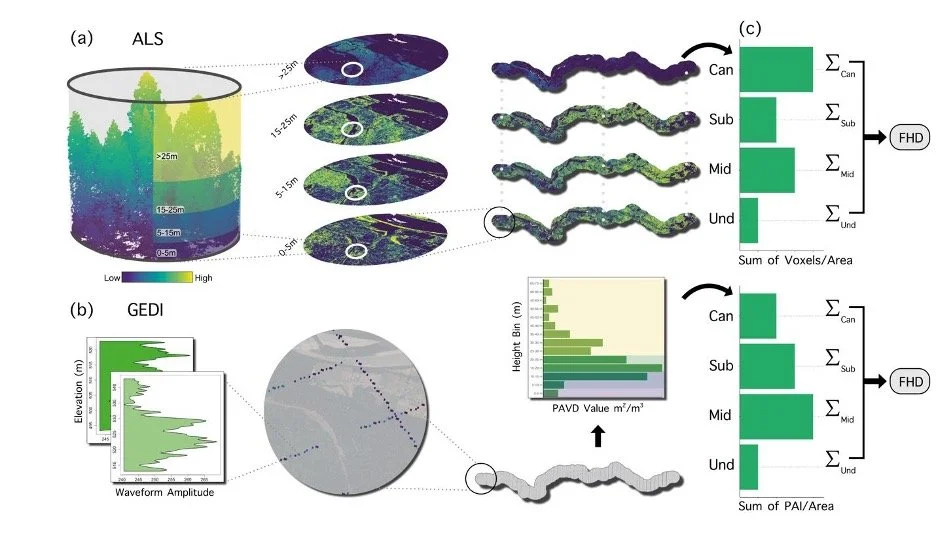
Colin led a paper that investigated whether NASA’s Global Ecosystem Dynamics Investigation (GEDI) mission data provide comparable results to other high-resolution Light Detection and Ranging (LiDAR) data, such as airborne laser scanning (ALS) LiDAR, for habitat structure and biodiversity research.
Abstract
NASA’s Global Ecosystem Dynamics Investigation (GEDI) mission has the potential to revolutionize habitat structure analysis in animal systems by enabling measurement of three-dimensional (3D) habitat structure at an unprecedented near-global scale. However, GEDI’s sampling methodology introduces data gaps that hinder its ability to capture landscape-scale habitat structure characteristics needed for biodiversity research. Despite its growing use, no study has explicitly tested whether GEDI provides comparable results to other high-resolution Light Detection and Ranging (LiDAR) data, such as airborne laser scanning (ALS) LiDAR, for habitat structure research. Here, we used a model-based validation framework to compare GEDI and ALS derived 3D habitat structure for biodiversity inference and prediction. Using two large-scale geospatial datasets spanning millions of LiDAR returns, we calculated structure within 1km of forested Breeding Bird Survey (BBS) across the continental US. We calculated species-level and community-level avian diversity indices and modeled their relationship with 3D habitat structure. We compared model parameter estimates between GEDI and ALS to assess differences in habitat-biodiversity relationships and evaluated how the two LiDAR sources differed in their ability to predict biodiversity. We found that ALS and GEDI led to different ecological inferences, with the degree of parameter agreement varying across regions, 3D structural metrics, and diversity indices. In contrast, both ALS and GEDI demonstrated comparable predictive performance when combined with other continental-scale environmental data. Our work suggests that while GEDI may miss important biodiversity-structure relationships at the landscape scale, it remains a powerful tool for prediction when used in conjunction with other environmental data.