
New paper: Fossil preservation biases affect ecological niche modeling
New Paper out!
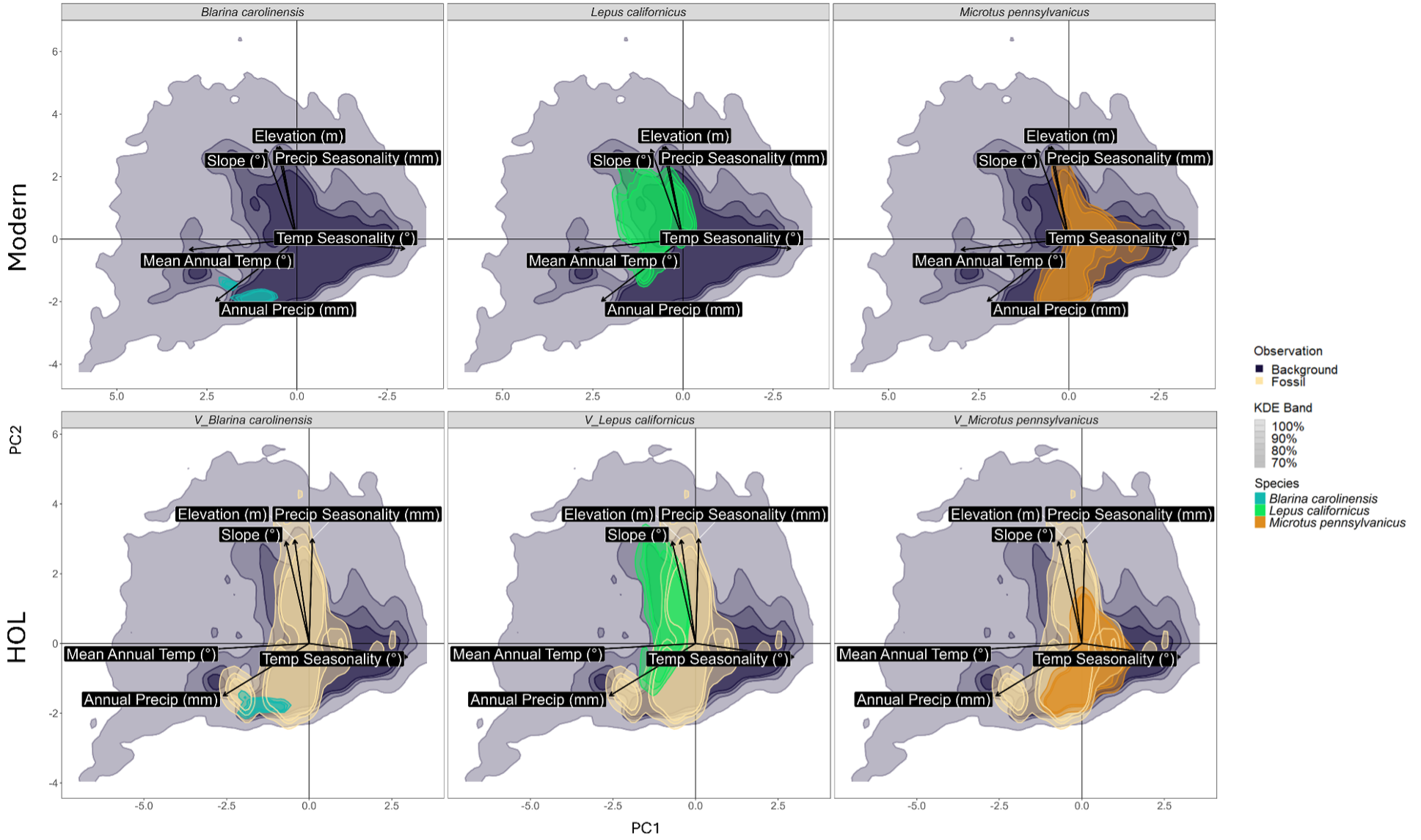
André, Marta and collaborators published a new paper showing that preservation biases in the fossil record distort species ecological niche and distribution models. The work was funded by the National Science Foundation grant.
Abstract
Ecological niche models (ENMs) increasingly leverage the fossil record to understand species’ environmental associations and predict their geographic distributions. However, fossils do not occur uniformly through time and space, which can compromise the robustness of ENMs and thus affect ecological conclusions. Here, we assessed how preservation biases in the fossil record impact our ability to reconstruct ecological niches and distributions of North American small mammals across three late Quaternary time periods (the Last Glacial Maximum, the deglacial period, and the Holocene). We found that preservation potential was highest in the Holocene and lowest during the deglacial period, with the differences driven by variations in climate and the prevalence of Holocene archaeological sites. In all intervals, warm, wet, and highly seasonal environments exhibited low preservation potential. These spatial and temporal differences in preservation potential significantly influenced niche reconstructions and geographic predictions, particularly impeding model quality when species niches extended beyond the preservation niche. We warn that such distortions can lead to erroneous ecological inferences, including inaccurate predictions of species responses to environmental changes and mischaracterizations of community assembly processes.